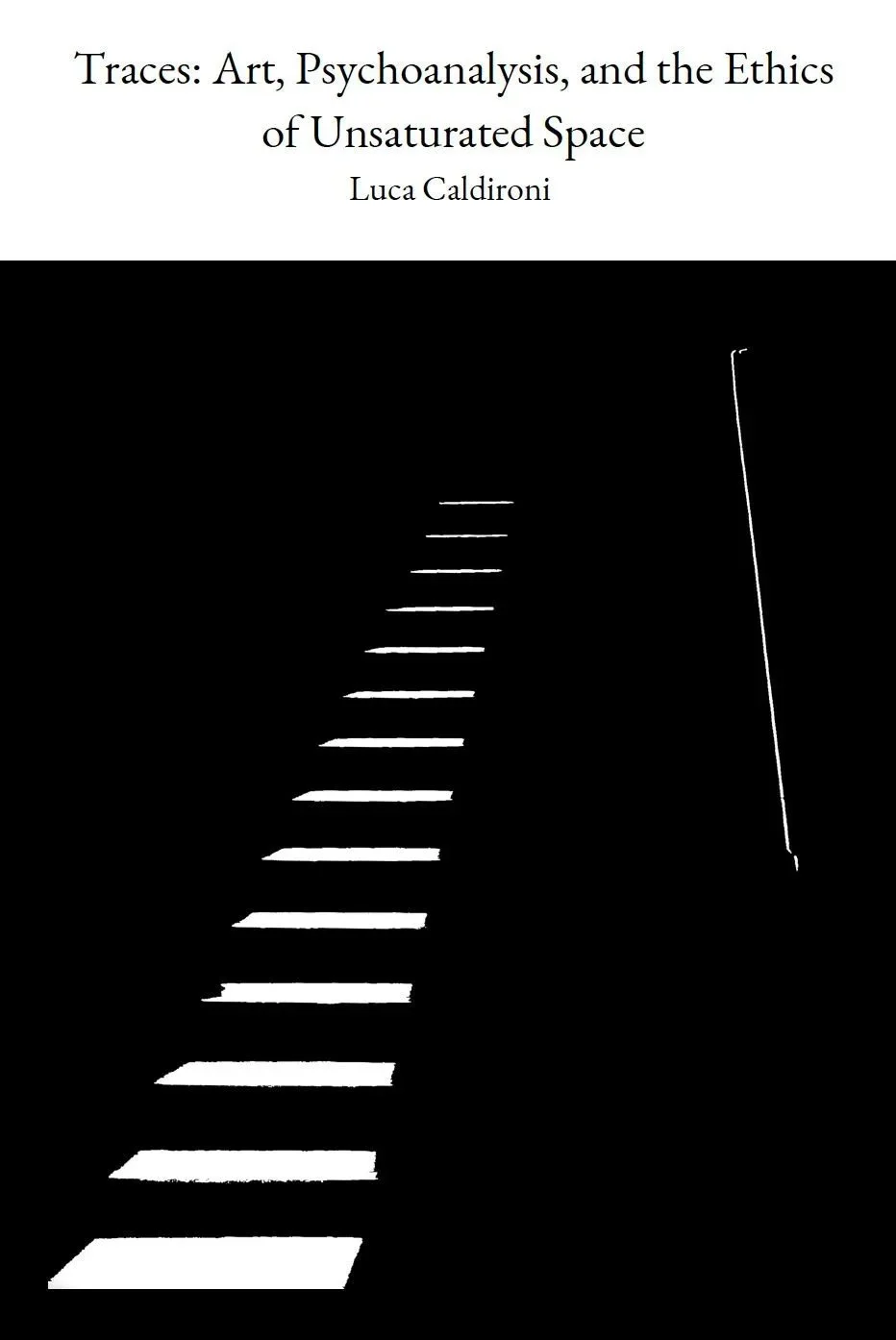
TRACES: Art, Psychoanalysis, and the Ethics of Unsaturated Space
Now available: the new book by Luca Caldironi, psychiatrist, psychoanalyst, and founder of Castello 925.
Published by Castello 925 – Non-Profit Cultural Association. All proceeds support the association’s cultural and research activities.
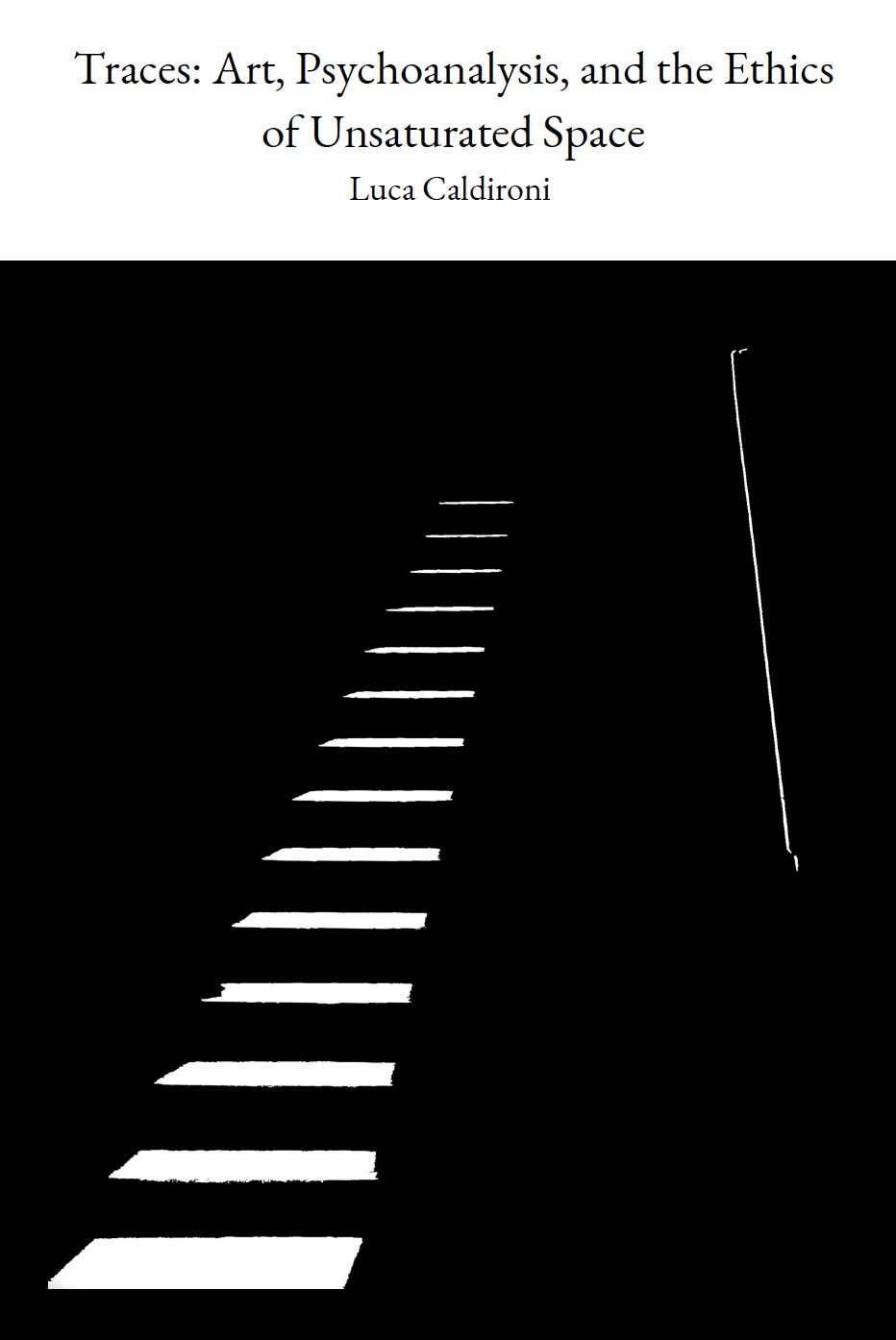
Drawing on the work of Wilfred Bion, the book explores the relationship between art, psychoanalysis, and contemporary culture through themes such as embodiment, generative AI, time, and transformation.
In a world increasingly shaped by prediction and optimization, Traces proposes the trace as a figure of orientation and defends incompletion as an ethical and creative necessity.vices designed to help you move forward with confidence, wherever you're headed next.
“TRACES” Presentation
A Conversation with Jen Dragon and Luca Caldironi
Jen: Let's begin with a simple question. Why did you write Traces?
Many people write books to explain something or offer answers. Traces seems to do something different. What first moved you to write it?
Luca: I didn't write this book because I felt I had answers to offer. I wrote it because I kept encountering questions that refused to disappear.
As a psychiatrist, psychoanalyst, and someone who has spent many years immersed in the world of contemporary art, I've spent much of my life working with people and artists trying to make sense of experiences that couldn't immediately be explained. Over time, I came to realize that psychoanalysis and art share something fundamental: neither begins with certainty. Both begin with attention.
Traces grew out of that realization. It is an invitation to remain close to experience before we rush to explain it.
Jen: Although you're Italian, you chose to write Traces directly in American English. That's a rather unusual decision for a first book. What inspired that choice? Was it simply about reaching a wider audience, or did writing in another language actually change the way you experienced and developed the ideas in the book?
Luca: People often ask me that.
Of course, writing in English allows the book to reach a wider audience. But there were several deeper reasons as well.
Writing in a language that isn't my native one forced me to think more carefully. I couldn't rely on familiar expressions or cultural habits. Every sentence had to be rediscovered. In many ways, writing in English became part of the very experience the book describes: remaining in uncertainty long enough for something genuinely new to emerge.
There was also a more personal reason. There is an old Latin saying, Nemo propheta in patria—"No one is a prophet in their own land." I don't interpret it as a criticism of one's homeland, but as a reminder that sometimes distance allows us to see more clearly. Stepping outside my native language helped me hear new resonances, discover unexpected meanings, and think in ways that might not have been possible otherwise.
And finally, writing this book in American English was also my way of expressing gratitude. Over the past several years, New York—and especially the extraordinary artists, scholars, friends, and colleagues I have met here—has welcomed me with remarkable generosity. This book is, in part, a way of giving something back. Not as a gesture of politeness, but as a sincere expression of appreciation for a community that encouraged me to think, create, and continue exploring new paths.
So presenting Traces here, in the Hudson Valley, feels especially meaningful to me. In some sense, it feels less like arriving with a finished book than like bringing a conversation back to the people and the place that helped make it possible.
Jen: The title is Traces. Why "traces"?
What does a trace represent for you, and why do you believe it is such an important image for understanding contemporary life?
Luca: A trace is different from a map.
A map tells you where to go. A trace simply tells you that someone—or something—has passed through before you.
I think contemporary life constantly asks us for certainty, while traces ask something different. They ask us to pay attention.
A trace doesn't eliminate uncertainty. It allows us to move within it.
Jen: Throughout the book you return to uncertainty—not as something to overcome, but as something to inhabit. Why?
Today we are surrounded by systems promising certainty, prediction, and quick solutions. Why do you believe uncertainty has become such an important ethical and psychological space?
Luca: Because uncertainty is not the opposite of thinking.
Very often it is the condition that makes thinking possible.
Today we live in a culture that values immediate answers, constant productivity, and prediction. But human experience doesn't unfold that way.
Love doesn't.
Grief doesn't.
Creativity doesn't.
The capacity to remain with uncertainty is not weakness. It is one of our deepest human strengths.
Jen: The psychoanalyst Wilfred Bion is a central presence throughout the book.
For someone who has never read Bion, what is the single most important idea you hope readers take away from his work?
Luca: If I had to summarize Bion in one sentence, I would say this:
The mind grows not by accumulating knowledge, but by becoming capable of transforming experience.
Bion taught us that thinking is not simply processing information. It is an emotional achievement.
His famous idea of approaching experience "without memory or desire" isn't about forgetting everything. It's about remaining sufficiently open for reality to surprise us.
Jen: The book constantly moves between psychoanalysis, art, philosophy, and neuroscience.
Why was it important for you not to remain inside the boundaries of one discipline?
Luca: Because human experience doesn't respect academic departments.
Artists, scientists, philosophers, and psychoanalysts often ask different versions of the same question: What does it mean to become human?
Each discipline illuminates something the others cannot fully explain.
I don't see these fields as competitors. I see them as different languages describing the same landscape.
Jen: You often describe art and psychoanalysis as sharing a common task.
What do artists and psychoanalysts actually have in common?
Luca: Both create spaces where something unexpected can appear.
Neither starts with certainty.
Neither can be reduced to technique.
A successful psychoanalytic session and a powerful work of art both leave us slightly different from how we entered them.
Neither tells us what to think.
Both expand our capacity for thinking.
Jen: One of the ideas that stayed with me throughout the book is your suggestion that art doesn't necessarily provide answers—it provides orientation. But you also seem to suggest that orientation doesn't always mean knowing exactly where we are going. Sometimes it may even require us to lose our way for a while. Could you explain what you mean by that? How can getting lost become part of both artistic creation and the psychoanalytic journey?
Luca: We often think of orientation as knowing exactly where we are.
I don't.
To me, orientation is not the opposite of getting lost. Sometimes getting lost is precisely what allows a deeper form of orientation to emerge.
Think of walking through an unfamiliar city like Venice. If you insist on following the shortest route, you may reach your destination quickly—but you'll probably miss the city itself. If, instead, you're willing to wander, to pause, to take unexpected turns, you begin to discover relationships that no map could have predicted.
I think art and psychoanalysis work in much the same way.
Neither offers a predefined path. Neither promises certainty. Both invite us to remain attentive while moving through territory that has not yet been fully mapped.
In psychoanalysis, moments of confusion, uncertainty, or even feeling lost are often not signs of failure. They may be the very conditions that allow something genuinely new to emerge. The same is true in artistic creation. The work often begins where our previous certainties no longer help us.
That is why I describe art as offering orientation rather than answers. Not because it tells us where to go, but because it gradually transforms the way we move through uncertainty.
Like a compass, it doesn't eliminate the unknown. It simply helps us remain sensitive to what is alive, even when the path disappears from view.
Perhaps the goal is not to avoid getting lost.
Perhaps it is to learn how to get lost without losing our capacity to pay attention.
Jen: Technology and artificial intelligence appear several times in the book.
Many people are afraid that AI will replace human creativity. You seem to have a more nuanced perspective. How do you see this relationship?
Luca: I don't think the most important question is whether AI will replace human beings. That question assumes that we already know what it means to be human—and I don't think we do.
What interests me much more is that we are living through one of those rare historical moments in which both technology and human subjectivity are evolving together. We are witnessing the emergence of what we might call a new technological subjectivity, but we cannot yet know what form it will ultimately take. It is still unfolding, and all of us are participating in that process, consciously or unconsciously.
That places us in a unique position. We cannot step outside this transformation and observe it from a distance because we are living inside it. Our relationship with artificial intelligence is therefore necessarily unfinished. It is experimental, evolving, and full of uncertainties.
AI will undoubtedly transform the way we work, remember, communicate, and create. But technology alone does not produce meaning. Meaning always emerges through human relationships, through dialogue, through culture, and through our capacity to transform experience rather than simply process information.
So, for me, the real question is not whether AI will become more intelligent. It almost certainly will. The real question is whether, alongside this extraordinary technological evolution, we will continue to cultivate those uniquely human capacities that cannot simply be automated: curiosity, imagination, ethical responsibility, emotional depth, the ability to tolerate uncertainty, and the courage to ask questions that have no immediate answers.
Artificial intelligence is not simply changing our tools. It is changing us. And we, in turn, are shaping what artificial intelligence will become. That is why I believe this is not only a technological revolution. It is also an anthropological, cultural, and ethical one. And like every profound transformation, it asks us not for certainty, but for attention.
Jen: One recurring idea is that thinking requires pauses, waiting, and the capacity to remain with what has not yet become clear. Do you think contemporary culture is making those capacities more difficult?
Luca: I do.
We live in a culture that increasingly equates speed with intelligence and immediate response with competence. But thinking doesn't always follow that rhythm.
Some experiences need time before they can become thought. They have to be lived, felt, revisited, and sometimes even endured before they gradually reveal their meaning.
My experience as a psychoanalyst has taught me that what matters most is often not what appears first, but what slowly emerges when we resist the temptation to close a question too quickly.
I think we are at risk of losing that capacity—not because technology is inherently harmful, but because we are becoming less familiar with waiting, with silence, and with the fertile uncertainty that precedes understanding.
To think is not simply to process information. It is to allow experience to transform us.
Perhaps one of the greatest challenges of our time is not simply to develop more powerful technologies, but to preserve the human spaces in which thought can still unfold at its own pace.
Some forms of understanding cannot be accelerated. Like a work of art—or like psychoanalytic work—they have their own time of gestation. Our task is not to make that process faster, but to protect the conditions that allow it to unfold.
Jen: You founded Castello 925 in Venice, an independent space dedicated to contemporary art and research.
How does Castello 925 relate to the ideas developed in Traces?
Luca: Castello 925 is, in many ways, Traces made physical.
It is not simply an exhibition space.
The exhibitions are only one part of the project.
The real work happens through dialogue.
Jen: Castello 925 is much more than an exhibition space. It seems to function as a place where artists, psychoanalysts, philosophers, scientists, and writers can meet and think together. What inspired you to create it, and what kind of experience were you hoping to make possible?
Luca: Castello 925 was never meant to be simply a gallery. From the beginning, I imagined it as a space for research, conversation, and unexpected encounters.
I've always believed that some of the most interesting ideas emerge not within disciplines, but at their boundaries. Artists, scientists, philosophers, psychoanalysts, architects, musicians—they all observe the world differently. When those perspectives genuinely meet, something new can emerge that none of them could have produced alone.
The exhibitions are important, of course, but they are only one part of the project. What matters even more are the conversations that continue before, during, and after them. In that sense, Castello 925 is less a place for displaying artworks than a place for cultivating thought.
Jen: Alongside Castello 925, you've also begun developing what you call the Knowledge Projects. How do they grow out of Castello 925, and how do they extend the ideas explored in Traces?
Luca: I see the Knowledge Projects as a natural evolution of the same vision.
If Castello 925 creates a physical space where unexpected encounters can happen, the Knowledge Projects aim to expand that possibility across disciplines, institutions, and even countries.
Traces is, in many ways, part of that larger journey. The book asks how we can remain open to uncertainty, complexity, and transformation. The Knowledge Projects ask a related question: how can we create environments where those qualities are not only discussed, but actually experienced?
Knowledge should not remain confined within isolated disciplines. Some of the most meaningful discoveries happen at the borders, where different languages, practices, and forms of experience meet.
One of the reasons I'm especially happy to be here in the Hudson Valley is that I see this region as a natural partner in that vision. There is an extraordinary concentration of artists, writers, thinkers, and independent cultural initiatives here. I hope this conversation is only the beginning of an ongoing exchange between the Hudson Valley and Venice—between Castello 925, the Knowledge Projects, and the remarkable creative communities that already exist here.
Ultimately, my hope is not simply to organize exhibitions or events, but to build lasting relationships and create the conditions for conversations, collaborations, artistic exchanges, and shared research that would not otherwise happen.
Because new forms of knowledge rarely emerge from certainty.
It almost always emerges from encounter.
Jen: It seems that Traces is not only a book, but the beginning of a much larger journey. Where do you hope this work will lead over the next few years?
Luca: I do see Traces as the beginning rather than the conclusion of something.
The book is the first step, but what interests me most is what can grow from it: conversations, workshops, artistic collaborations, educational initiatives, and, eventually, digital spaces where people can practice thinking rather than simply consume information.
I also hope to deepen the dialogue between Venice and the Hudson Valley, creating opportunities for artists, writers, psychoanalysts, scholars, and cultural institutions to learn from one another. I don't imagine these places as separate worlds, but as communities that can enrich one another through sustained exchange.
For me, the book opens a door.
What matters now is not simply that people read it, but what new conversations, relationships, and possibilities begin after they walk through that door.
Jen: If someone reads Traces, visits Castello 925, or becomes involved in one of the Knowledge Projects, what do you hope they take away from the experience?
Luca: More than anything, I hope they leave with a different relationship to uncertainty.
Not with more answers, but with greater confidence in their capacity to remain with questions.
I hope they feel permission to slow down.
To pay attention.
To remain curious.
To recognize that not everything meaningful can be measured by efficiency or immediate results.
If Traces offers anything, I hope it is this: the realization that uncertainty is not always an obstacle to life.
Sometimes it is where life quietly begins.
Jen: Looking back at your life—as a psychiatrist, psychoanalyst, founder of Castello 925, and now as a writer—do these feel like different careers, or different expressions of the same search?
Luca: From the outside, they probably look like different professions.
To me, they've always been different expressions of the same search.
I've always been interested in one question:
How does something new become possible?
Whether I'm sitting with a patient, working alongside an artist, creating a place like Castello 925, or writing a book, I'm ultimately exploring the same mystery: how human beings transform experience into meaning.
Jen: Before we open the conversation to the audience, I'd like to ask about the subtitle of your book: Art, Psychoanalysis, and the Ethics of Unsaturated Space. It's a beautiful phrase, but also an intriguing one. What do you mean by an "unsaturated space," and why do you think it has an ethical dimension?
Luca: The idea of an unsaturated space comes largely from Bion, but I believe it extends far beyond psychoanalysis.
An unsaturated space is one that has not already been filled with ready-made meanings, fixed interpretations, or predetermined conclusions. It is a space that remains open enough for something genuinely new to emerge.
In art, that openness allows the viewer to become part of the work rather than simply consume it.
In psychoanalysis, it allows patient and analyst to discover something together that neither could have known or thought in advance.
More broadly, I think it is also an ethical idea.
To leave a space unsaturated is an act of respect. It means resisting the temptation to impose certainty too quickly. It means allowing another person, another culture, or another way of thinking to reveal something we could not have imagined on our own.
Perhaps this is one of the greatest challenges of our time. We live in a world that constantly pushes us toward immediate explanations, instant opinions, and premature certainty.
An ethics of unsaturated space asks something different.
It asks us to remain open.
To tolerate not knowing.
To make room for surprise.
Perhaps that is what an ethics of unsaturated space really is: not the ethics of providing answers, but the ethics of protecting the conditions in which new meanings, new relationships, and new forms of life may still emerge.